Personal growth
The Compound Effect by Darren Hardy: Summary and Study Notes
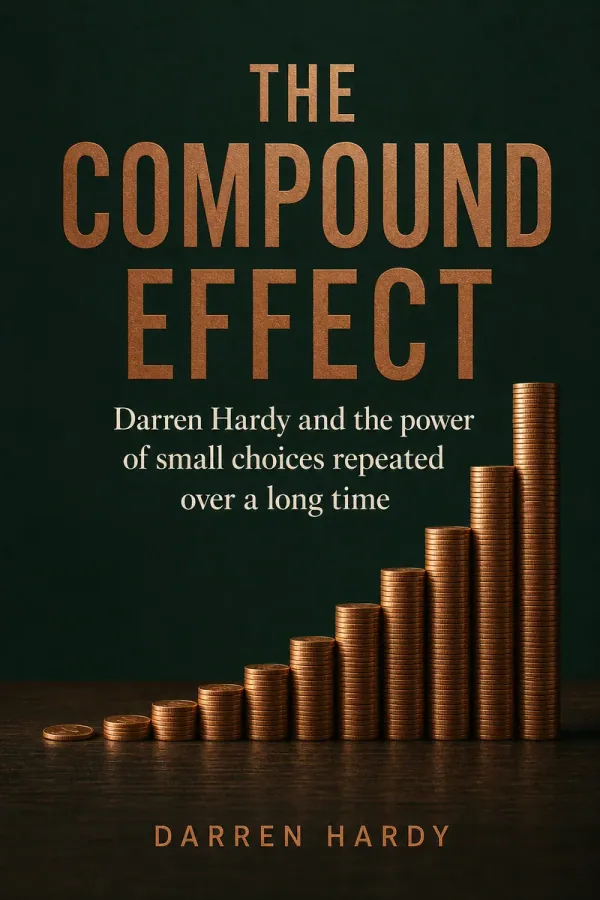
Darren Hardy and the power of small choices repeated over a long time
Study this topic in OriaThe essentials
Published in 2010 by Darren Hardy, then head of the American magazine SUCCESS, The Compound Effect has become a self-help classic. Its idea: our results don't come from a single stroke of brilliance, but from the accumulation of small daily choices. You'll discover its formula, the parable of the magic penny, the story of the three friends, its advice on habits, momentum and influences, the author's career and what research says about its limits.
Key dates and facts
- 2007
- Hardy becomes publisher of SUCCESS magazine
- 2010
- First edition of The Compound Effect
- 2020
- 10th-anniversary edition from Hachette
- 2020
- French translation, L'Effet cumulé
- 2007
- Publisher of SUCCESS magazine
- 2010
- The Compound Effect
- 2011
- Living Your Best Year Ever
- 2015
- The Entrepreneur Roller Coaster and departure from SUCCESS
📘 A book born in the world of SUCCESS magazine
The Compound Effect, published in French as L'Effet cumulé, is a self-help book by the American Darren Hardy. Its first edition came out in 2010 from Success Books, the publishing house tied to SUCCESS magazine, of which Hardy was then the publisher. Its original subtitle sums up the project: multiplying your success, “one simple step at a time.”
📏 A short, direct book
The book is brief: under 200 pages in its first version. It opens with a message from the famous American coach Tony Robbins, then moves through six chapters with very simple titles: the compound effect in action, choices, habits, momentum, influences and acceleration. Hardy promises “the truth on success,” with no gimmicks and no hyperbole, drawing on what he says he learned from years of interviewing figures from the business world.
📚 Reissues and translations
The book was quickly picked up by a larger publisher, Vanguard Press. In September 2020, for its tenth anniversary, it was reissued by Hachette Go, an imprint of the Hachette group, with a subtitle promising to “jumpstart your income, your life, your success.” The same year, Cynthia Piaud's French translation was published by Diateino as L'Effet cumulé : décuplez votre réussite !
The book's official website claims more than two million copies sold worldwide and spots on the New York Times, USA Today and Wall Street Journal bestseller lists. These figures come from the author himself.
🧭 Which tradition?
The Compound Effect belongs to the long American tradition of success books, made up of practical advice, anecdotes and easy-to-remember formulas. Hardy cites in particular the influence of Jim Rohn (1930–2009), a motivational speaker who also inspired Tony Robbins. His book came out eight years before James Clear's Atomic Habits, which takes up the same intuition of small gains that add up.
➕ The formula and the magic penny
The heart of The Compound Effect, Darren Hardy's book, fits into a formula the author repeats throughout the text.
According to Hardy, it is the principle of reaping huge rewards from a series of small, smart choices. His formula: small, smart choices + consistency + time = radical difference.
The word compound refers to compound interest in finance: when the interest on an investment itself earns interest, savings grow faster and faster. Hardy applies this logic to health, work, money and relationships. For him, there is no magic shortcut: success is built slowly, through actions that seem insignificant at the time.
🪙 Three million or a penny?
To drive the point home, the book opens with a question. Would you rather receive $3 million right now, or a magic penny that doubles in value every day for 31 days? Most people take the millions. Yet on the thirty-first day, the penny is worth:
0.01 × 2^30 ≈ 10.7 million dollars
The most striking thing is the pace. On day twenty, the penny is still worth only about $5,000: it looks like a terrible choice. On day thirty, it reaches about $5.4 million, then doubles one last time. Most of the result shows up in the very last days.
⏳ Success that is invisible at first
This is the lesson Hardy wants readers to take away: at first, the compound effect is invisible. You make an effort without seeing any change, and many people give up just before the results become visible. Conversely, bad habits do no immediate damage, which is what makes them dangerous: one dessert too many or an evening in front of a screen changes nothing… until the day their effects have piled up.
The message is therefore as much a call for patience as for action. The point is not to change everything at once, but to choose small, sound actions and stick with them long enough.
The rest of the course
This page publishes the first 2 parts. The full course has 9: here is what the next ones cover.
- 👬 Larry, Scott and Brad: three paths
The central example in Darren Hardy's The Compound Effect: three friends who start out alike make slightly different choices, and after 31 months their lives have diverged radically.
- 🧭 Choices, responsibility and tracking
The chapter on choices in Darren Hardy's The Compound Effect: taking full responsibility for your results, the formula for luck, and the habit of writing down your behaviors to become aware of them.
- 🔁 Habits: “why-power” rather than willpower
The chapter on habits in Darren Hardy's The Compound Effect: the role of automatic behaviors, motivation drawn from your values rather than from willpower, and methods for replacing a bad habit.
- 🚂 Momentum and acceleration
Two chapters of Darren Hardy's The Compound Effect: momentum, which makes consistency easier and easier thanks to morning and evening routines, and acceleration, which means doing more than expected at decisive moments.
- 🧲 Influences: what you read, who you spend time with, where you live
The chapter on influences in Darren Hardy's The Compound Effect: what you take in (media, reading), the people you spend time with and your environment, three forces that steer our choices without our realizing it.
- ✍️ Darren Hardy, the SUCCESS magazine man
The biography of Darren Hardy, author of The Compound Effect: a childhood with a football-coach father, an entrepreneur at 18, self-improvement TV networks, publisher of SUCCESS magazine, then speaking and online mentoring.
- ⚖️ Reception, criticism and limits
The reception of Darren Hardy's The Compound Effect and its limits: popular with entrepreneurs, criticized as repetitive and obvious, and what research says about habits, luck and survivorship bias.
Study “The Compound Effect” with flashcards and quizzes
In Oria, you read the full course, then practice on it: flashcards, multiple-choice quizzes, open questions or the Feynman method. Cards and questions then come back in your daily review, paced by spaced repetition.
Study this topic in OriaSources
These notes draw on the sources below. If a point seems doubtful, refer back to them.