Personal growth
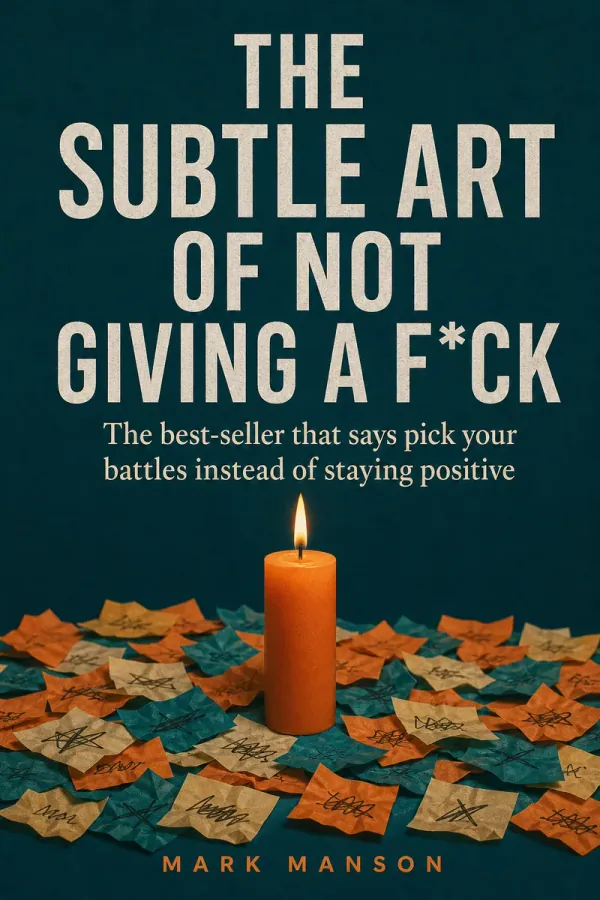
The Subtle Art of Not Giving a F*ck by Mark Manson: Summary and Study Notes
The best-seller that says pick your battles instead of staying positive
Study this topic in OriaThe essentials
Published in 2016, The Subtle Art of Not Giving a F*ck by the American Mark Manson sold millions of copies by pushing back against self-help books that promise permanent happiness. Its idea: life is made of problems, and what matters is choosing the right ones, meaning the values we're willing to suffer for. You'll discover the backwards law of positivity, the Disappointment Panda, good and bad values, the difference between responsibility and fault, a case for doubt, and what critics hold against the book.
Key dates and facts
- 2015
- The blog post that started it all
- 2016
- Published in the United States
- 2017
- French translation published by Eyrolles
- 2023
- Adapted into a documentary film
- 1984
- Mark Manson is born
- 2008
- First blog
- 2016
- The Subtle Art of Not Giving a F*ck
- 2019
- Everything Is F*cked
- 2021
- Will , co-written with Will Smith
📘 A blog post that became a world best-seller
The Subtle Art of Not Giving a F*ck: A Counterintuitive Approach to Living a Good Life is a self-help book by the American blogger Mark Manson, published on September 13, 2016 by HarperOne, an imprint of HarperCollins.
💻 From a blog post to a book
It all started online. In 2015, Manson published a blog post with the same title. Reading the thousands of messages from his readers, he had noticed that much of their unhappiness came from caring about the wrong things. The post struck a chord, and he turned it into a book.
🚀 A lasting success
The book entered the New York Times bestseller list at number six in early October 2016 and reached number one for the first time in July 2017. By September 2024, it had spent a total of 327 weeks on the list. In 2017, it was the top-selling nonfiction title at the American chain Barnes & Noble. By July 2024, it had sold more than 20 million copies, and the author's website lists translations into 65 languages.
📢 A title that sells
The original title contains a swear word, softened by an asterisk on the cover. The New York Times even printed it on its list with a row of dashes. The book became the best-known example of a 2010s trend: crude titles in bookstores, in self-help but also in cookbooks or coloring books. In 2018, journalist Ruth Graham noted in Slate that this kind of shock value had become routine.
🎬 A 2023 film
In 2023, the book was adapted into a documentary film directed by Nathan Price, narrated by Mark Manson himself and distributed by Universal Pictures. Running about 1 hour 37 minutes, it was released in the United States in January 2023.
🙃 Against positivity at all costs
The Subtle Art of Not Giving a F*ck starts as a reaction against the self-help industry. Mark Manson accuses it of selling an unexamined positivity that is neither practical nor useful for most people. His book argues the opposite: it's life's difficulties that give it meaning.
✍️ "Don't try," Bukowski's lesson
The first chapter is titled "Don't Try," named after the philosophy of the American writer Charles Bukowski, one of the book's major inspirations. Those two words are engraved on Bukowski's gravestone. In a 1963 letter, the poet explained that you shouldn't force inspiration, or chase fame or immortality, but wait for it to come. Manson sees this as an invitation to stop wanting, at all costs, to be better, richer, or happier.
🔄 The backwards law
Manson draws on an idea from philosopher Alan Watts, which he calls the "backwards law." The more you chase a positive experience, the worse you feel, because pursuing something keeps reminding you that you don't have it. Desperately trying to be rich reminds you that you're not; desperately trying to be happy reminds you that you're not. Conversely, accepting your negative experiences is, paradoxically, a positive experience.
🌀 The feedback loop from hell
Manson describes a spiral he calls "the feedback loop from hell": you're anxious, then anxious about being anxious; angry, then angry at having gotten angry; guilty, then guilty about feeling guilty. It's our reactions to our emotions that cause us pain, more than the emotions themselves. According to him, social media and consumer culture make this worse, constantly showing us lives that look more successful than our own and pushing us to always want more. The way out is to accept feeling bad, without turning it into an additional drama.
🎯 Not giving a f*ck isn't being indifferent
The title might suggest a case for indifference. It's the opposite. In the blog post that started the book, Manson makes several clarifications:
- not giving a f*ck doesn't mean being indifferent: it's about not caring about what's secondary, so you can save your energy for what truly matters. He recounts that when he learned his mother had been scammed, he didn't shrug it off at all: he fought for her;
- to avoid being overwhelmed by small annoyances, you need something more important to hold on to. Someone who argues over a few cents off a coupon probably doesn't have much else going on;
- we have a limited amount of attention and energy. As we age, we learn to become selective and stop caring about everything.
For Manson, the real question isn't whether we're going to care about something, but what we choose to care about.
The rest of the course
This page publishes the first 2 parts. The full course has 9: here is what the next ones cover.
- 🐼 Happiness is a problem
The second chapter of Mark Manson's book: the Disappointment Panda, the idea that a problem-free life doesn't exist, the role of emotions, and the importance of loving the struggle rather than the victory.
- 🌍 You are not special
The third chapter of Mark Manson's book: a critique of the cult of specialness, a case for an ordinary life, the role of technology, and what it actually takes to excel.
- ⚖️ The value of suffering: good and bad values
The heart of Mark Manson's book: our values determine our problems, the difference between good and bad values, and the idea that choosing better values gives you a better life.
- 🧭 Responsibility, doubt, and failure
Chapters 5 through 7 of Mark Manson's book: we always choose, the difference between responsibility and fault, a case for doubt, Manson's law, and failure as an engine.
- 🚪 Learning to say no, and remembering you will die
The last two chapters of Mark Manson's book: the importance of refusal, healthy relationships without dependency, the conflict that builds trust, and awareness of death as a compass.
- ✍️ Mark Manson, the author
The life and career of Mark Manson, author of The Subtle Art of Not Giving a F*ck: a childhood in Texas, studies in Boston, dating advice blogs, then self-help books.
- ⚖️ Reception, criticism, and limits
The reception of Mark Manson's The Subtle Art of Not Giving a F*ck and its limits: glowing reviews, a provocative title, a privileged viewpoint, borrowed ideas, and a lack of scientific grounding.
Study “The Subtle Art of Not Giving a F*ck” with flashcards and quizzes
In Oria, you read the full course, then practice on it: flashcards, multiple-choice quizzes, open questions or the Feynman method. Cards and questions then come back in your daily review, paced by spaced repetition.
Study this topic in OriaSources
These notes draw on the sources below. If a point seems doubtful, refer back to them.