Personal growth
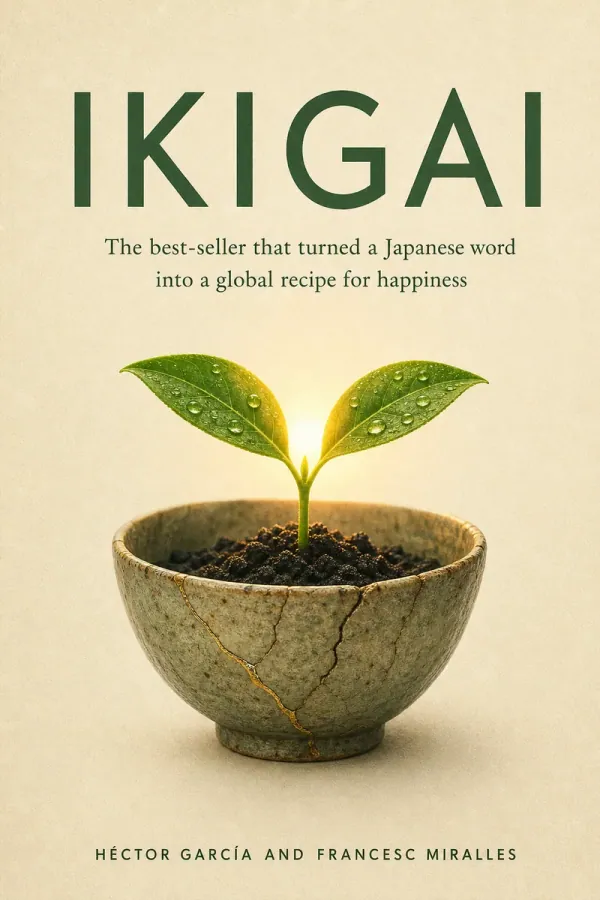
Ikigai by Héctor García and Francesc Miralles: Summary and Study Notes
The best-seller that turned a Japanese word into a global recipe for happiness
Study this topic in OriaThe essentials
Published in Spain in 2016, Héctor García and Francesc Miralles's Ikigai has sold several million copies worldwide. The book starts from a Japanese word meaning “reason for being” and from a visit to a village in Okinawa famous for its centenarians. You'll discover its big ideas (the four-circle diagram, logotherapy, flow, diet, resilience), who its authors are, and why Japanese researchers and observers strongly qualify its message.
Key dates and facts
- 1966
- Mieko Kamiya publishes a book on ikigai in Japan
- 2009
- Dan Buettner's TED talk on centenarians
- 2014
- The four-circle diagram goes viral
- 2016
- Ikigai published in Spain
- 2017
- French and English editions
- 1968
- Francesc Miralles born in Barcelona
- 1981
- Héctor García born in Calpe
- 2004
- García moves to Japan
- 2016
- Ikigai published
📗 A little book that became a global phenomenon
Ikigai is a self-help book written by two Spaniards, the engineer Héctor García and the writer Francesc Miralles. It first appeared in Spanish in March 2016 under the title Ikigai: los secretos de Japón para una vida larga y feliz (“the secrets of Japan for a long and happy life”). It was published in France in 2017 by Fleuve éditions, in a translation by Marianne Millon, then in paperback by Pocket in 2018. That same year, 2017, Penguin launched it in English as Ikigai: The Japanese Secret to a Long and Happy Life.
🌍 A success counted in millions
The book is short, about two hundred pages, and can be read in a few hours. Yet it has become one of the biggest global successes in self-help. The figures vary by source and date: in 2022, The Economist and the Japanese government's official website spoke of more than 3 million copies and a translation into 63 languages; the American publisher Penguin now claims more than 5 million copies, and Héctor García's website more than 10 million. It has been translated into more than sixty languages: 62, 63, or 70 depending on the source.
🧭 A word more than a theory
In Japanese, ikigai (生き甲斐) combines iki, “life,” and kai, “what is worthwhile.” The Oxford English Dictionary defines it as “a motivating force; something or someone that gives a person a sense of purpose or a reason for living.” So there is nothing secret about the word. It has long been common in Japan, and as early as 1966 the psychiatrist Mieko Kamiya devoted an important book to it, Ikigai ni tsuite (“About Ikigai”), inspired by her work with leprosy patients.
Outside Japan, the word spread mainly after journalist Dan Buettner's 2009 TED talk, which presented ikigai as one of the keys to longevity in Okinawa. García and Miralles's book rode and then amplified this wave, at the same time as the book by the Japanese neuroscientist Ken Mogi, published in English in 2017. Their promise fits in one sentence: everyone supposedly has an ikigai, and finding it would help you live a happier and longer life.
⭕ Finding your reason for being: the four circles
For Ikigai, Héctor García and Francesc Miralles's book, ikigai is a reason for being: what makes you want to get out of bed in the morning. The authors describe it as a place of balance, where a person's needs, ambitions, skills, and satisfaction meet. In their view, our ikigai is hidden deep inside each of us, and finding it takes patient searching.
🔵 Four intersecting questions
The book takes up a diagram that has gone around the world: a Venn diagram made of four overlapping circles. Each circle asks a question:
- What do I love doing?
- What am I good at?
- What does the world need?
- What can I be paid for?
The areas where two circles overlap have names: what you love and what you are good at form your passion; what you love and what the world needs, your mission; what the world needs and what you can be paid for, your vocation; what you are good at and what you can be paid for, your profession. Ikigai supposedly lies at the center, where all four meet. The diagram speaks above all to people looking for meaningful work, which explains its huge success on professional networks such as LinkedIn.
🔎 A drawing that doesn't come from Japan
Yet this diagram is not Japanese. It started as a diagram about “purpose” in life, drawn in 2011 by the Spanish astrologer Andrés Zuzunaga. In 2014, the British entrepreneur Marc Winn published a version on his blog in which he replaced the word “purpose” with “ikigai.” Winn himself now acknowledges it: he says he merely added a single word to a shape that already existed. His post went viral, and the diagram was then taken up in García and Miralles's book.
A Japanese word formed from iki (“life”) and kai (“what is worthwhile”). It refers to whatever gives life value or joy: people, such as one's children or friends, or activities, such as work or a hobby. In Japan, it is not tied to any particular diagram.
Keeping this history in mind helps you read the book with some distance: the diagram is a useful tool for reflection, but it blends an old Japanese notion with a Western framework centered on career and money.
The rest of the course
This page publishes the first 2 parts. The full course has 9: here is what the next ones cover.
- 🧠 From logotherapy to Morita therapy
How Ikigai links the search for a reason for being to two therapeutic approaches: Viktor Frankl's logotherapy and Japanese Morita therapy.
- 🌊 Flow: losing yourself in what you do
The role of flow, the state of total absorption described by Mihaly Csikszentmihalyi, in Ikigai, and the authors' advice for entering it more often.
- 🏝️ Ogimi, the village of centenarians
The investigation the authors of Ikigai carried out in Ogimi, in northern Okinawa: the centenarians they interviewed, work without retirement, bonds of friendship (moai), and morning exercises.
- 🥢 Eating until 80% full and varying your plate
Ikigai's dietary advice inspired by Okinawa: the hara hachi bu rule, a variety of vegetables and fruit, tea, and what we really know about it.
- 🍂 Resilience, wabi-sabi, and ten rules
The last part of Ikigai: resilience in the face of hardship, the Japanese aesthetic of wabi-sabi, and the ten rules of ikigai proposed by the authors.
- ✍️ Héctor García and Francesc Miralles
The two authors of Ikigai: Héctor García, a Spanish engineer living in Japan since 2004, and Francesc Miralles, a novelist and essayist from Barcelona, and their later books.
- ⚖️ Reception, criticism, and limits
What Japanese observers, demographers, and researchers say about Ikigai: an everyday word in Japan, a Western diagram, a disputed Okinawan longevity, and studies that are only correlational.
Study “Ikigai” with flashcards and quizzes
In Oria, you read the full course, then practice on it: flashcards, multiple-choice quizzes, open questions or the Feynman method. Cards and questions then come back in your daily review, paced by spaced repetition.
Study this topic in OriaSources
These notes draw on the sources below. If a point seems doubtful, refer back to them.