Personal growth
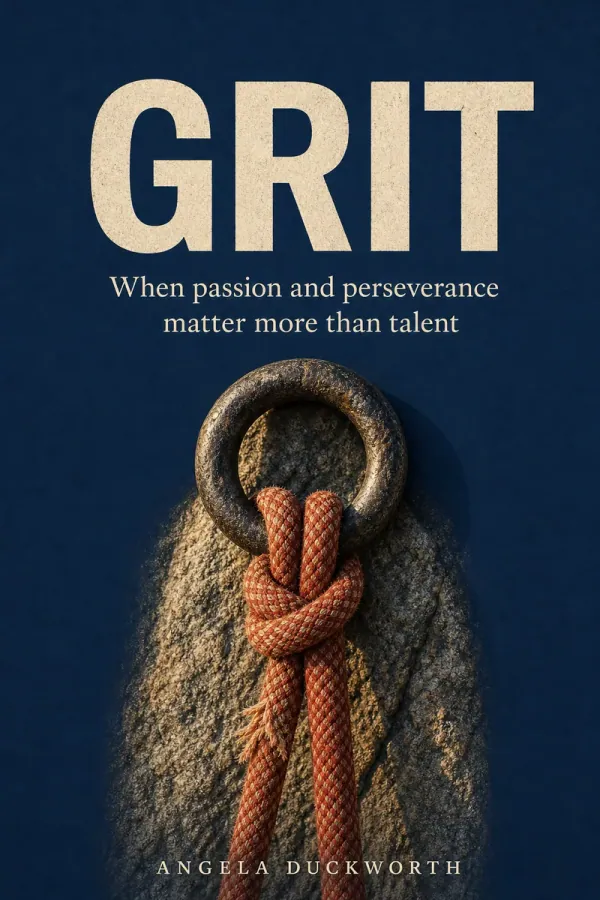
Grit by Angela Duckworth: Summary and Study Notes
When passion and perseverance matter more than talent
Study this topic in OriaThe essentials
Published in 2016, Angela Duckworth's Grit turned an English word, "grit," into a buzzword in schools and companies. Its idea: for long-term success, passion and perseverance may matter as much, or more, than talent. You'll discover the definition of grit, the studies at West Point and the American spelling bee, the two equations of effort, the four resources that feed tenacity, the "Hard Thing Rule," and what the 2017 meta-analysis by Credé and colleagues revealed about its limits.
Key dates and facts
- 2007
- First research paper on grit
- 2013
- MacArthur Fellowship and TED talk
- 2016
- Grit published in the United States
- 2017
- French edition, L'Art de la niaque
- 2007
- Founding paper and the twelve-question scale
- 2009
- Short version and the West Point cadet study
- 2013
- TED talk on grit
- 1970
- Born in Philadelphia
- 2006
- PhD in psychology
- 2013
- MacArthur Fellowship
📘 A word that became trendy
Grit: The Power of Passion and Perseverance is the first book by American psychologist Angela Duckworth, a professor at the University of Pennsylvania. It was published in May 2016 by Scribner and spent 21 weeks on the New York Times bestseller list.
🔤 A hard word to pin down
In everyday English, grit literally means gravel or sand, and figuratively the toughness of someone who never gives up. In this chapter, we keep the English term, which has become standard in psychology.
🚀 From a research paper to a phenomenon
The book builds on research that began well before it. In 2007, Duckworth and three colleagues published a paper in a leading psychology journal that defines grit and proposes a questionnaire to measure it. In 2013, she received the prestigious MacArthur Fellowship, nicknamed the "genius grant," and her TED talk on grit, recorded in April of that year, went around the world. In the United States, a 2015 education law revived interest in students' character traits. By the time the book came out, the New York Times review presented Duckworth as the psychologist who had turned grit into the buzzword of debates about education.
👪 "You're no genius"
The preface opens with a personal memory. As a child, Angela Duckworth often heard her father, a Chinese immigrant and chemist by trade, tell her she was no genius. Obsessed with intelligence, he worried his children wouldn't go far. Years later, she would go on to receive the very fellowship nicknamed "for geniuses." From this she draws the question that guides the whole book: what if what we ultimately achieve depends more on passion and perseverance than on innate talent?
"In the long run, Dad, grit may matter more than talent."
Angela Duckworth, Grit (2016)
The book unfolds in three parts: what grit is and why it matters; how to cultivate it from the inside, through four psychological resources; and how the people around us, parents, activities, and a group's culture can grow it from the outside.
🧗 Passion and perseverance: defining grit
In Grit, Angela Duckworth gives a short definition that she repeats everywhere: grit is passion and perseverance in the service of long-term goals.
A character trait that combines perseverance of effort with consistency of interests over the years. A person with grit stays on the same course for a long time, despite setbacks, difficulties, and slow progress.
🚫 What grit is not
To define it more precisely, Duckworth says what it isn't. It's not talent. It's not luck. Nor is it the intensity of wanting something in the moment. Grit consists of having what some researchers call an "ultimate concern": a goal that matters so much it organizes and gives meaning to almost everything you do, and to which you stay committed even when you fall, make mistakes, or progress slowly.
🧩 Two components
In Duckworth's work, grit has two facets:
- perseverance of effort: continuing to work hard despite obstacles and setbacks;
- consistency of interests: staying passionate about the same goal for years, instead of switching projects every few months.
This distinction matters, since later research showed that the two facets carry very different weight.
📝 The Grit Scale
To study grit scientifically, Duckworth created a questionnaire, the Grit Scale, by asking highly accomplished people in various fields what drove their success. Respondents answer statements about their own consistency and perseverance and get a score from 1 to 5. The original 2007 version has twelve questions, a short 2009 version has eight, and the book offers a ten-question version so readers can easily calculate their own score.
⚠️ A tool to use with caution
Duckworth herself stresses the limits of her questionnaire. It's easy to inflate your score. Above all, it suffers from a reference bias: everyone judges themselves by their own standards, so a score measures both a person's grit and how demanding they are of themselves. She therefore believes the scale is suited to research and personal reflection, but not for hiring employees, admitting students, evaluating teachers, or comparing schools and countries.
The rest of the course
This page publishes the first 2 parts. The full course has 8: here is what the next ones cover.
- 🎖️ West Point, the spelling bee, and the Chicago schools
The studies that made grit famous: from Angela Duckworth's math students to West Point cadets, the National Spelling Bee, and Chicago high schoolers.
- ➗ Talent, effort, and the two equations
Angela Duckworth's thesis on talent and effort: distrust talent, the two equations where effort counts twice, the hierarchy of goals, and the idea that grit can grow.
- 🌱 The four resources: interest, practice, purpose, hope
The four psychological resources that, according to Angela Duckworth, feed grit from the inside: interest, deliberate practice, purpose, and hope.
- 🏡 Growing grit from the outside
The role of the people around us according to Angela Duckworth: the "Hard Thing Rule" at home, extracurricular activities, group culture, and the importance of living conditions.
- ✍️ Angela Duckworth, the author
The life and career of Angela Duckworth, author of Grit: a childhood in New Jersey, studies in neuroscience, consulting, teaching, a PhD in psychology, and research.
- ⚖️ Reception, criticism, and limits
The reception of Angela Duckworth's Grit and the scientific criticism: the 2017 meta-analysis by Credé and colleagues, its link to conscientiousness, Ericsson's objections, and the debate over schools.
Study “Grit” with flashcards and quizzes
In Oria, you read the full course, then practice on it: flashcards, multiple-choice quizzes, open questions or the Feynman method. Cards and questions then come back in your daily review, paced by spaced repetition.
Study this topic in OriaSources
These notes draw on the sources below. If a point seems doubtful, refer back to them.