Personal growth
The Life-Changing Magic of Tidying Up by Marie Kondo: Summary and Study Notes
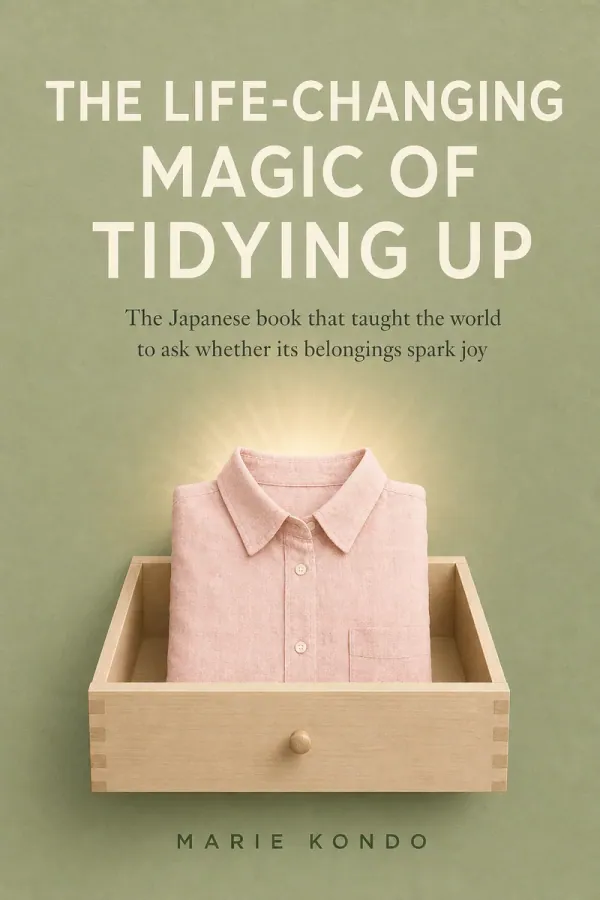
The Japanese book that taught the world to ask whether its belongings spark joy
Study this topic in OriaThe essentials
First published in Japan at the end of 2010, Marie Kondo's The Life-Changing Magic of Tidying Up has sold millions of copies and inspired a Netflix series. Her method, known as KonMari, calls for a single great tidying session, category by category, guided by one question: does this object spark joy? You'll discover its main rules, the life of its author, the role of Shinto in her view of objects, and the criticism it has drawn.
Key dates and facts
- 2010
- Published in Japan by Sunmark
- 2014
- English translation in the United States
- 2015
- French edition and Time ranking
- 2019
- The series Tidying Up with Marie Kondo on Netflix
- 1984
- Born in Japan
- c. 2004
- First clients at 19
- 2010
- Publication of her first book
- 2019
- Netflix series and Emmy nomination
📙 A best-seller from Japan
The Life-Changing Magic of Tidying Up is the first book by Marie Kondo, a Japanese tidying consultant. It came out in Japan from the publisher Sunmark at the end of 2010 (sources give December 27, 2010 or January 2011), under the title Jinsei ga tokimeku katazuke no mahō, which could be rendered as “the magic of tidying that makes life flutter.” In it she lays out her approach, the KonMari Method, named after a nickname formed from her family name and her first name.
🗾 A Japanese phenomenon first
The book arrived in a country where decluttering was already fashionable. In 2009, the writer Hideko Yamashita had launched danshari, an art of “refusing, discarding, letting go” of superfluous possessions. Yet The Life-Changing Magic of Tidying Up quickly stood out: it sold more than 1.3 million copies in Japan and became the country's second best-selling book in the first half of 2012. A sequel appeared the same year, and the network NTV adapted it into a TV movie broadcast in 2013.
🇺🇸 A worldwide success that took time
The English translation, The Life-Changing Magic of Tidying Up, was published in the United States on October 14, 2014 by Ten Speed Press, with almost no promotion: its author did not speak English, which made radio and TV appearances difficult. According to The New York Times Magazine, the spark was an article in The New York Times in which a journalist described her own attempt to tidy her closets the Kondo way. By 2016, the book had spent 86 weeks on the paper's bestseller list. In France, it came out in February 2015 from Éditions First, translated by Christophe Billon.
Sales figures vary by source: nearly 6 million copies in 2016 according to The New York Times, more than 8 million in 2018, and more than 10 million today according to other sources. Marie Kondo's official website says the book has been translated into 44 languages and that her books together have sold more than 14 million copies. In 2015, Time magazine named her one of the 100 most influential people in the world.
🎉 Tidy once and for all
The first idea in The Life-Changing Magic of Tidying Up, Marie Kondo's book, goes against a very common piece of advice. Many guides recommend tidying little by little, a shelf here, a drawer there. For Kondo, that approach dooms you to tidy forever without ever reaching the end. Instead, she proposes one single great tidying, complete and intense, carried out in one sustained push.
⏳ A tidying “festival”
Kondo presents this great tidying as a special event, almost a celebration. It is not an evening of cleaning before guests arrive, but a project you decide to see through to the end. According to The New York Times Magazine, this once-in-a-lifetime tidying marathon takes six months on average. On her website, Kondo turns it into her first two rules: commit yourself to tidying up, and take the time to imagine the life you would like to live in your home.
The promise is ambitious: sort everything properly once, and you would never slide back into clutter. The book claims that her clients have kept their homes tidy over the long term, a claim based on her experience as a consultant rather than on a study.
🗑️ Sort first, put away later
The second principle: finish discarding before you organize. Until you have decided what to keep, there is no point looking for where to put it. Once the sorting is done, you know exactly how many things need a home, and you often discover there are far fewer left than you expected.
Marie Kondo's tidying method: gather all your belongings, one category at a time, keep only those that spark joy, then give every item you keep a fixed place.
Kondo is also wary of ready-made solutions. For her, buying boxes, baskets or storage furniture often just hides the problem: you store things better, but you never ask yourself why you own so much. It is not a question of tools, but of decisions.
The rest of the course
This page publishes the first 2 parts. The full course has 7: here is what the next ones cover.
- 🗂️ By category, and in the right order
The central rule of Marie Kondo's KonMari Method: sort by category rather than by room, in the order clothes, books, papers, komono and finally sentimental items.
- ✨ “Does this spark joy?”
The single sorting criterion of Marie Kondo's KonMari Method: hold each item in your hands and keep only those that bring joy (tokimeku), then thank the ones you let go.
- 👕 A place for everything
How Marie Kondo's KonMari Method stores what remains: a fixed place for every item, vertical folding of clothes, papers in three groups, respect for objects and the influence of Shinto.
- 👩 Marie Kondo, a childhood passion
The life of Marie Kondo, author of The Life-Changing Magic of Tidying Up: her childhood passion for tidying, her start as a consultant at 19, her years at a Shinto shrine, her life in the United States and her Netflix series.
- ⚖️ Reception, criticism and limits
The “Kondo effect” after the Netflix series, criticism from professional organizers, the controversies over books and her online shop, her own relaxed standards after three children, and what research says about clutter.
Study “The Life-Changing Magic of Tidying Up” with flashcards and quizzes
In Oria, you read the full course, then practice on it: flashcards, multiple-choice quizzes, open questions or the Feynman method. Cards and questions then come back in your daily review, paced by spaced repetition.
Study this topic in OriaSources
These notes draw on the sources below. If a point seems doubtful, refer back to them.