Business & money
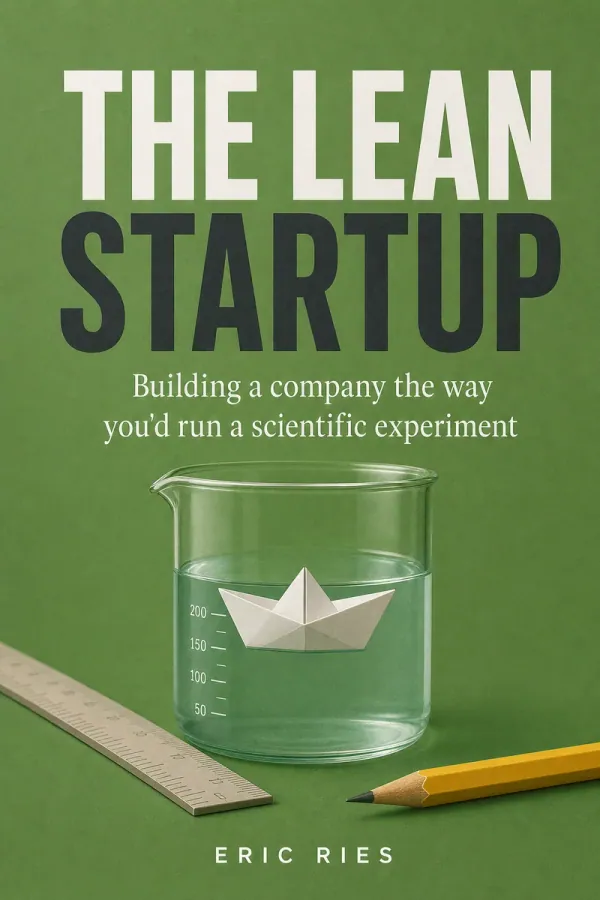
The Lean Startup by Eric Ries: Summary and Study Notes
Building a company the way you'd run a scientific experiment
Study this topic in OriaThe essentials
Published in 2011, Eric Ries's The Lean Startup changed how entrepreneurship is taught. Instead of writing a long business plan and working for years in secret, the book proposes testing ideas very quickly with real customers. You'll discover where the method comes from, the build-measure-learn loop, the minimum viable product, the pivot, innovation accounting, the author's own career, and what researchers think of its strengths and its limits.
Key dates and facts
- 2003
- There.com fails
- 2004
- IMVU is founded
- 2008
- Blog post, "The lean startup"
- 2011
- The book is published
- 1978
- Eric Ries is born
- 2015
- Kickstarter campaign for The Leader's Guide
- 2017
- The Startup Way
- 2019
- The SEC approves the Long-Term Stock Exchange
📘 A book born of several failures
The Lean Startup is a book by the American entrepreneur Eric Ries, published in September 2011 by Crown Business. Its subtitle explains how today's entrepreneurs use "continuous innovation" to build radically successful companies. The word lean refers to launching a product while wasting as little time and money as possible.
💥 Two founding failures
Ries built his method out of his own setbacks. As a student at Yale University, he co-founded Catalyst Recruiting, a site connecting students and employers. The company raised funding but collapsed along with the bursting of the dot-com bubble. According to Ries, it failed because its founders had not understood what their customers wanted and had poured too much energy into launching their first product.
He then joined There, Inc., a Silicon Valley startup building a 3D virtual world. Ries describes it as a textbook case: five years of secretive research and development, $40 million in funding, and nearly 200 employees by the time of its launch, in 2003. The product failed to attract much interest beyond its earliest curious users. The main mistake, in his view: a vision that was "almost too concrete," which kept the team from seeing that the product did not match demand. In both cases, he concludes, the team started from the technology instead of starting from the needs it was meant to meet.
🧑💻 The IMVU experience
In 2004, Ries co-founded IMVU, a social network, with Will Harvey, one of the founders of There.com. One of the investors, the entrepreneur-turned-professor Steve Blank, required the company's leaders to take his entrepreneurship course at Berkeley. There, Ries discovered Blank's method and combined it with practices from software development. IMVU shipped a very simple first version within six months and eventually pushed new code live close to 50 times a day.
In 2008, Ries published a blog post titled "The lean startup," which launched the movement. Invited to speak at major conferences and named entrepreneur-in-residence at Harvard Business School, he went on to devote himself entirely to spreading his method. The 2011 book debuted directly at number two on the New York Times bestseller list in its category.
🏭 From Toyota to Silicon Valley
The name of Eric Ries's method is no accident: The Lean Startup carries over to young companies ideas drawn from the Japanese auto industry and from software engineering.
🚗 The Toyota model
The word lean was popularized in 1990 by the book The Machine That Changed the World, which described the Toyota Production System, developed by the engineer Taiichi Ohno. This system treats any spending that fails to create value for the end customer as waste. It seeks to cut inventory, produce only what is actually ordered, and catch defects as early as possible on the line, so as not to waste time finishing a flawed product.
A management approach aimed at eliminating anything that does not create value for the customer. Applied to startups, it means not spending months building something nobody wants. As the movement itself points out, being lean has nothing to do with how much money a company has raised.
🗣️ Steve Blank's "customer development"
The second source is the work of Steve Blank. In The Four Steps to the Epiphany (2005), an early draft of which Ries reviewed, Blank criticizes startups for focusing solely on product development. Instead, he proposes customer development: learning as early as possible who the customers are and what problems they actually have. His method has four steps: customer discovery, customer validation, customer creation, and company building.
From this, Ries takes away a now-famous instruction: get out of the building. A company cannot be designed solely from behind a screen; founders need to meet real customers to test their assumptions.
💻 What software contributed
Finally, Ries draws on "agile" software development, which favors short, frequent releases over a single finished product delivered after years of work. Steve Blank also cites the influence of researchers Rita Gunther McGrath and Ian MacMillan, who developed "discovery-driven planning." Ries brought these different ideas together into a single method, with a simple, memorable vocabulary.
The rest of the course
This page publishes the first 2 parts. The full course has 8: here is what the next ones cover.
- 🔄 The build-measure-learn loop
The heart of The Lean Startup: treating every idea as a hypothesis to be tested, through the build-measure-learn loop and validated learning.
- 🧪 The minimum viable product
The minimum viable product (MVP) in The Lean Startup: definition, the Zappos example, continuous deployment, and A/B testing.
- ↪️ Pivot or persevere
The pivot in The Lean Startup: changing the fundamental hypothesis when experiments call for it, with the examples of Groupon, Criteo, and PayPal.
- 📊 Innovation accounting
How The Lean Startup proposes to measure a startup's progress: innovation accounting, useful metrics, and vanity metrics.
- 👤 Eric Ries, engineer turned theorist
The career of Eric Ries, author of The Lean Startup: an early programmer, co-founder of IMVU, advisor, and later the creator of a new stock exchange on Wall Street.
- ⚖️ Influence, limits, and debates
The influence of The Lean Startup on companies, schools, and governments, and researchers' criticisms: the evidence, its limits, and cases where the method doesn't fit.
Study “The Lean Startup” with flashcards and quizzes
In Oria, you read the full course, then practice on it: flashcards, multiple-choice quizzes, open questions or the Feynman method. Cards and questions then come back in your daily review, paced by spaced repetition.
Study this topic in OriaSources
These notes draw on the sources below. If a point seems doubtful, refer back to them.