Business & money
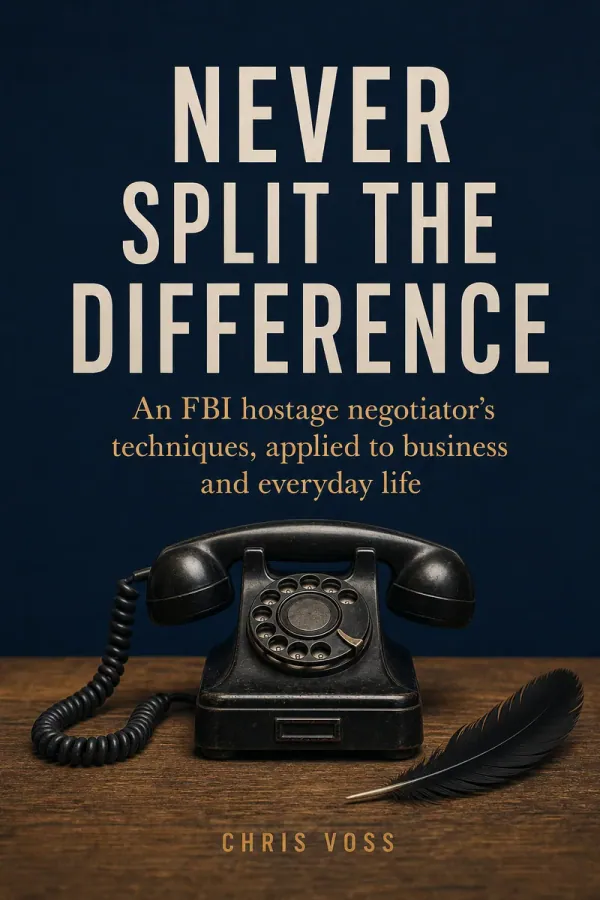
Never Split the Difference by Chris Voss: Summary and Study Notes
An FBI hostage negotiator's techniques, applied to business and everyday life
Study this topic in OriaThe essentials
Published in 2016, Chris Voss's Never Split the Difference, co-written with journalist Tahl Raz, carries the methods of hostage negotiation into the world of business. Its core idea: we are not rational calculators, and understanding the other side's emotions is what gets you a better deal. You'll discover tactical empathy, mirroring and labeling, the art of aiming for “no,” calibrated questions, and the hunt for “black swans,” followed by who Chris Voss is and what negotiation experts criticize about the book.
Key dates and facts
- 1992
- Voss is trained in hostage negotiation
- 2007
- Leaves the FBI and founds the Black Swan Group
- 2016
- Never Split the Difference is published
- 2018
- French edition released by Belfond
- 1957
- Born in Iowa
- 1992
- Trains in hostage negotiation
- 2003
- Becomes the FBI's lead negotiator for international kidnappings
- 2007
- Leaves the FBI
📘 An FBI negotiator writes a manual
Never Split the Difference is a book by Chris Voss, a former FBI hostage negotiator, written with journalist Tahl Raz. It was published in 2016 in the United States by Harper Business, then in French in 2018 by Belfond, translated by David Rochefort, under the title Ne coupez jamais la poire en deux (literally, “never cut the pear in two”).
💡 From the field to the classroom
According to Publishers Weekly, the idea for the book came while Voss was taking an executive negotiation course at Harvard: he realized that the techniques he had used to save hostages were also highly effective in the business world. The book blends true stories from his FBI career with practical lessons presented as usable anywhere: at work, at home, or facing a salesperson or an employer.
“Kidnappers are just businessmen trying to get the best price.”
Chris Voss, Never Split the Difference (2016)
🍐 Why never split the difference?
The title sums up the book's thesis. Splitting the difference means reaching a compromise: each side gives up part of what it wants to land on a middle-ground deal. For Voss and his consulting firm, the Black Swan Group, that instinct is often a trap. A compromise frequently produces a mediocre deal that satisfies no one, and it breeds resentment, because we feel our losses more strongly than our gains.
The book therefore pushes back against part of traditional negotiation teaching, which it sees as too focused on logical reasoning. Its starting point is simple: we don't negotiate with machines, but with human beings driven first and foremost by their emotions.
🧠 Negotiating with humans, not calculators
The entire method in Never Split the Difference, the book by former FBI negotiator Chris Voss, rests on one idea: we are not rational. We react on instinct first, then justify our choices with logic afterward. The book's own pitch says it plainly: fairness doesn't really exist, compromise costs more than it delivers, and chasing “yes” causes deals to fail.
📉 The fear of losing
Voss draws on the work of psychologist Daniel Kahneman, winner of the Nobel Prize in Economics, and his prospect theory. It shows that the pain of losing a given amount is stronger than the pleasure of gaining the same amount: this is loss aversion. In negotiation, this explains why a “fair” compromise on paper can still leave everyone frustrated, and why framing an offer as a loss to avoid is often more effective than framing it as a gain.
🤝 Tactical empathy
The ability to understand the other side's situation and emotions, then show them you've understood, by clearly voicing their point of view. It builds trust and surfaces information — it is not about giving in.
This concept is the heart of the book. Voss insists on one distinction: understanding is not the same as agreeing. At the FBI, his job meant putting himself in the shoes of kidnappers or terrorists, grasping their mindset and motives, without ever sharing their goals. Here, empathy is a tool: it lowers tension and reveals what the other side actually wants.
⚖️ The trap word: “fair”
Voss is wary of the word “fair,” which he nicknames the “F-word.” When someone claims they've made a fair offer, it's often pressure meant to make you cave. His advice is to propose examining the facts together, on the condition that the offer can change if the facts call for it. Conversely, he recommends stating up front, yourself, that you want the other person to feel they're being treated fairly, and that they can stop you at any time if they feel otherwise.
The rest of the course
This page publishes the first 2 parts. The full course has 8: here is what the next ones cover.
- 🪞 Mirrors, labels, and the late-night FM DJ voice
Chris Voss's first set of tools: repeating the other person's last words (mirroring), naming their emotions (labeling), defusing accusations with an accusation audit, and choosing the right tone of voice.
- 🙅 Aiming for “no” and for “that's right”
Two counterintuitive ideas from Chris Voss: seeking “no” rather than “yes,” which reassures the other person, and drawing out a “that's right” that shows you've truly understood them.
- ❓ The illusion of control: calibrated questions
Chris Voss's calibrated questions, which open with “how” or “what,” like “How am I supposed to do that?”, plus his advice for making sure a deal actually gets carried out.
- 💰 Bargaining hard and hunting for black swans
The final part of Chris Voss's method: preparing to bargain, framing the discussion, using precise numbers, and then hunting for “black swans” — those hidden pieces of information that change everything.
- 🕵️ Chris Voss, from the FBI to consulting
Who is Chris Voss, the author of Never Split the Difference: an FBI agent for 24 years, lead negotiator for international kidnappings, then founder of the Black Swan Group and a teacher.
- ⚖️ Reception, criticism, and limits
The success of Never Split the Difference, then its limits: techniques designed for one-off crises that are hard to transfer to lasting relationships, and the ethical question of manipulation.
Study “Never Split the Difference” with flashcards and quizzes
In Oria, you read the full course, then practice on it: flashcards, multiple-choice quizzes, open questions or the Feynman method. Cards and questions then come back in your daily review, paced by spaced repetition.
Study this topic in OriaSources
These notes draw on the sources below. If a point seems doubtful, refer back to them.