Business & money
Rich Dad Poor Dad by Robert Kiyosaki: Summary and Study Notes
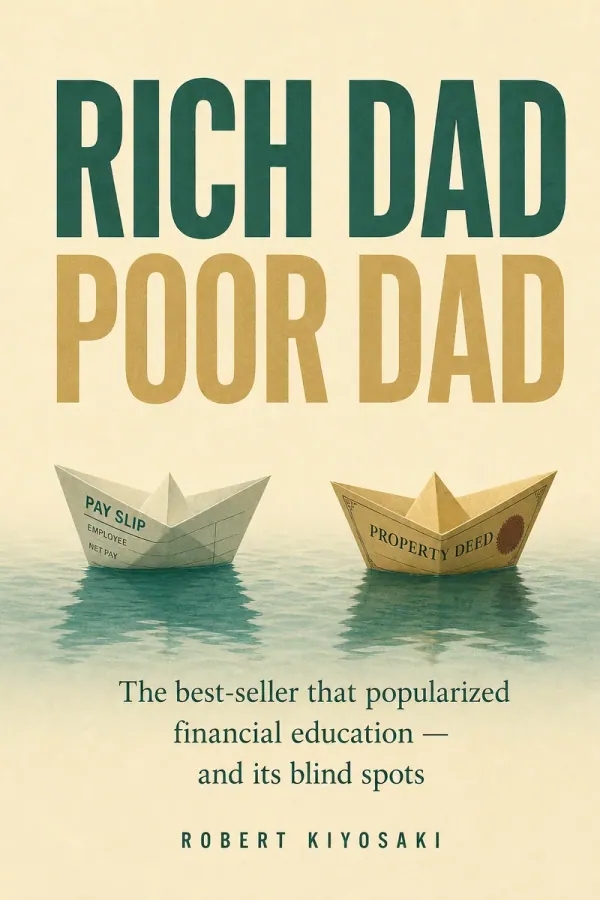
The best-seller that popularized financial education — and its blind spots
Study this topic in OriaThe essentials
Self-published in 1997, Rich Dad Poor Dad pits two father figures against each other: an educated civil servant who's always short on cash, and an entrepreneur who makes his money work for him. You'll discover the book's core ideas, from the difference between assets and liabilities to the financial education schools never teach, then the story of its worldwide success. You'll also see why it's been fiercely criticized: the disputed existence of the "rich dad," advice some call reckless, controversial seminars, and the bankruptcy of one of the author's companies.
Key dates and facts
- 1947
- Robert Kiyosaki is born in Hilo, Hawaii
- 1970
- His father, running for lieutenant governor, loses the race
- 1997
- Self-publication of Rich Dad Poor Dad
- 1996
- Launch of the Cashflow 101 game
- 1997
- Self-published
- 2000
- Reissued by Warner Business Books
- 2017
- 20th-anniversary edition: roughly 40 million copies claimed
- 1956
- Richard Kimi opens the Hotel Hukilau in Hilo
- 2003
- Kiyosaki compares the rich dad to Harry Potter in SmartMoney
- Dec. 2008
- Richard Kimi dies in Honolulu
🌺 Two dads in Hawaii
Rich Dad Poor Dad is a personal finance book published in 1997 by American author Robert Kiyosaki, written with accountant Sharon Lechter. Its subtitle lays out the plan: to reveal what the rich teach their kids about money that the poor and the middle class do not.
👨👦 A story told as a fable
The book presents itself as a series of parables drawn from the author's own life. Robert Kiyosaki was born in 1947 in Hilo, Hawaii, into a family of Japanese descent. He describes growing up under the influence of two men with opposite attitudes toward money, work, and school:
- The "poor dad" is his own father, an educated man who worked hard his whole life without ever reaching financial security.
- The "rich dad" is the father of his best friend, Mike: a savvy entrepreneur who, according to the book, became one of the richest men in Hawaii through his businesses and investments.
According to the story, young Robert decides around age nine to follow the rich dad's example. The whole book then compares, lesson after lesson, what each of the two dads supposedly taught him.
🏫 The real father: an educator
Kiyosaki's father, Ralph Kiyosaki, really was a figure in Hawaii's education system: he was appointed head of the state's school system. In 1970, he ran as the Republican candidate for lieutenant governor and lost. He then lost his job, sank his savings into an ice cream franchise that eventually failed, and went on to work for labor unions. This path is the model for the "poor dad" figure: educated, respected, but financially vulnerable.
🎭 Neither novel nor memoir
Critic Rob Walker, writing in Slate, points out that the book's trick is to blur the line between parable and memoir. Readers feel they're reading a true story, even though many details stay vague. This ambiguity would later fuel criticism of the book, especially around whether the rich dad ever existed.
💸 Don't work for money
The most famous idea in Robert Kiyosaki's Rich Dad Poor Dad fits in one line: you shouldn't work for money, you should make money work for you. For the author, simply chasing a bigger salary doesn't make you rich.
🔁 Escaping the "rat race"
Kiyosaki calls the "rat race" the trap of people whose entire income comes from their job and goes right back out to cover expenses: as long as you depend on a paycheck, you're running in circles. In his view, so many people get stuck there because nobody ever taught them how money actually works.
Getting out means building sources of passive income — income that arrives without trading your time for a wage: rent, dividends, profits from a business you own. This is one of the pillars of his thinking: real financial independence comes from passive income, not from a diploma or a traditional job.
📏 Measuring wealth in days
Kiyosaki borrows a definition of wealth that he credits to the American futurist Buckminster Fuller, whom he presents as a former mentor. Wealth isn't measured by the size of a paycheck, but by the number of days you could survive without working, living only off the income your assets produce.
According to Kiyosaki and Lechter, you reach it when the monthly income from your assets exceeds your monthly expenses. At that point, you no longer need a paycheck to live.
🎲 A board game before the book
These ideas first took shape as a game. In 1996, Kiyosaki launched Cashflow 101, a board game in which each player moves a small plastic rat. The goal is to escape the "rat race," the board's inner loop, by building enough investment income to cover expenses; players then move up to the "fast track," the outer loop. Instead of a scoresheet, each player fills out their own financial statements. According to the Wikipedia article on the game, the rulebook Kiyosaki originally wrote for it grew into the book Rich Dad Poor Dad.
The game also features small impulse purchases called doodads: landing on one of these squares pushes you to buy items that quickly become a financial burden. It's the playable version of another key idea in the book: the line between assets and liabilities.
The rest of the course
This page publishes the first 2 parts. The full course has 8: here is what the next ones cover.
- 📊 Assets and liabilities, Kiyosaki's way
Kiyosaki's very personal definitions of assets (what puts money in your pocket) and liabilities (what takes it out), and the controversial claim that your home is a liability.
- 🏫 The financial education school skips
The book's critique of school, the importance of financial intelligence, and its ideas about taxes and using companies.
- 🏗️ Invest, build, own
The path the book recommends: owning businesses and real estate rather than being employed, and how Kiyosaki's thinking later extended to debt, gold, and cryptocurrency.
- 📚 From self-published book to global phenomenon
How a book rejected by publishers became one of the best-selling personal finance books ever, and the "Rich Dad" franchise it spawned.
- 🔎 Did the "rich dad" really exist?
Doubts about the rich dad's existence, Kiyosaki's evasive answers, and the late identification of Richard Kimi, a Hilo hotelier.
- ⚠️ Risky advice, seminars, and bankruptcies: the criticism
The serious criticisms: advice deemed wrong or dangerous, lack of concrete method, controversial seminars, the bankruptcy of Rich Global LLC, and other failed ventures.
Study “Rich Dad Poor Dad” with flashcards and quizzes
In Oria, you read the full course, then practice on it: flashcards, multiple-choice quizzes, open questions or the Feynman method. Cards and questions then come back in your daily review, paced by spaced repetition.
Study this topic in OriaSources
These notes draw on the sources below. If a point seems doubtful, refer back to them.