Business & money
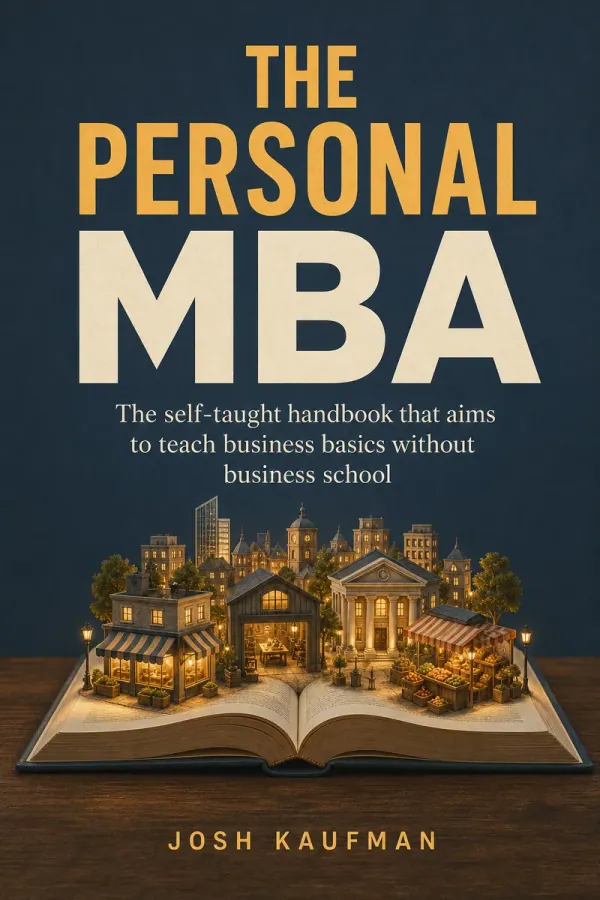
The Personal MBA by Josh Kaufman: Summary and Study Notes
The self-taught handbook that aims to teach business basics without business school
Study this topic in OriaThe essentials
Published at the end of 2010, Josh Kaufman's The Personal MBA sums up in a few hundred “mental models” what you need to know to understand a business, without going through an expensive MBA. You'll discover the five parts of every business, the art of creating value and testing it, sales and finance without jargon, the pitfalls of the human mind, systems thinking, the author's career and the debate over the real value of business schools.
Key dates and facts
- 2005
- First Personal MBA reading list
- 2008
- Kaufman leaves Procter & Gamble
- 2010
- The book is published by Portfolio
- 2020
- 10th-anniversary edition
📚 From a reading list to a best-seller
The story of The Personal MBA begins in the mid-2000s in Cincinnati, in the United States. Josh Kaufman was working there as an assistant brand manager at the headquarters of Procter & Gamble, on household products such as Mr. Clean and Swiffer. Hired straight out of the University of Cincinnati, he was surrounded by colleagues and bosses who almost all held an MBA, the prestigious Master of Business Administration. So as not to feel left behind, he started reading economics and management textbooks, on his lunch break and at the public library.
💡 The spark of 2005
In March 2005, Harvard Business School rescinded the admission of 119 applicants who had hacked into its computer system to find out their results early. Kaufman read the author Seth Godin's comment on his blog: in Godin's view, Harvard was actually doing these applicants a favor by handing them back $150,000 in tuition and two years of their lives, which real-world experience and the careful reading of thirty or forty books would replace to good advantage. Kaufman then realized that his personal approach could help others.
Within a few days, he published online a list of recommended books forming a “personal MBA,” followed by a manifesto encouraging people to educate themselves. The site quickly drew a large audience. The list now includes 99 titles.
📖 The book
Kaufman left P&G in 2008 to devote himself to his project, from Colorado. The book came out at the end of 2010 from Portfolio, an imprint of the Penguin group, followed by a new edition in 2012. The French translation, Le Personal MBA, came out in 2013 from Leduc.s. A revised and expanded 10th-anniversary edition was published on September 1, 2020: it presents 271 concepts across eleven chapters. According to the author's website, the book has sold more than a million copies.
Kaufman himself describes it as an introduction: giving, in a minimum of time, a clear and complete overview of the most important ideas in the business world.
🧩 The five parts of every business
The first chapter of The Personal MBA, Josh Kaufman's book, starts from a deliberately simple definition. A business, he explains, is a repeatable process that creates something of value that other people want, at a price they are willing to pay, in a way that satisfies them, and that brings in enough money for its owners to want to keep going.
🔗 Five linked activities
For Kaufman, every business, from the solo freelancer to the multinational, comes down to five processes that follow one another:
- Value creation: discovering what people need or want, then creating it.
- Marketing: attracting attention and building demand for what you have created.
- Sales: turning prospective customers into paying customers.
- Value delivery: giving customers what you promised and making sure they are satisfied.
- Finance: bringing in enough money to keep going and make the effort worthwhile.
🕳️ When a piece is missing
The test is simple: take away any one of these five parts, and it is no longer a business. Kaufman gives each gap a name. A venture that doesn't create value for others is a hobby; one that doesn't attract attention, a flop; one that doesn't sell, a nonprofit; one that doesn't deliver what it promises, a scam; one that doesn't bring in enough money, a business that will eventually close.
A simple way of representing how some part of the world works. The Personal MBA is built as a collection of these models, each summed up in a few pages, to help you understand and improve any activity.
For the author, business is not rocket science: it is about identifying a problem and solving it in a way that benefits both parties. Anyone who makes it more complicated, he adds, is either trying to impress you or to sell you something you don't need. Before launching or analyzing a project, he therefore advises describing these five processes precisely: if you can't, you don't yet understand your idea well enough.
The book's first five chapters follow exactly this order. The next six move from the business to the people who make it run, and then to the systems within which it operates.
The rest of the course
This page publishes the first 2 parts. The full course has 9: here is what the next ones cover.
- 💡 Creating value and testing it
The value creation chapter of The Personal MBA: the Iron Law of the Market, core human drives, the twelve standard forms of value, evaluating a market, the hassle premium, the minimum viable offer and shadow testing.
- 🤝 Attract, sell, deliver
The marketing, sales and value delivery chapters of The Personal MBA: attracting attention, setting a price, value-based selling, negotiating and keeping your promises.
- 💰 Finance without jargon
The finance chapter of The Personal MBA: profit, sufficiency, value capture, the four ways to increase revenue and bootstrapping.
- 🧠 The human mind and working on yourself
The psychology chapters of The Personal MBA: Caveman Syndrome, akrasia, the four ways to complete a task, the cost of switching attention, Parkinson's Law and the planning fallacy.
- ⚙️ Thinking in systems
The last three chapters of The Personal MBA: understanding, analyzing and improving systems, with Gall's Law, the constraint, the 80/20 rule and the iteration cycle.
- ✍️ Josh Kaufman, the independent educator
The career of the author of The Personal MBA: studies at the University of Cincinnati, a career at Procter & Gamble, his departure in 2008, consulting, then books on rapid learning.
- ⚖️ Reception, criticism and limits
The reception of The Personal MBA and its limits: success among entrepreneurs, the debate over the real value of MBAs, what economic research says and the author's own reservations.
Study “The Personal MBA” with flashcards and quizzes
In Oria, you read the full course, then practice on it: flashcards, multiple-choice quizzes, open questions or the Feynman method. Cards and questions then come back in your daily review, paced by spaced repetition.
Study this topic in OriaSources
These notes draw on the sources below. If a point seems doubtful, refer back to them.